Neuromind Pro Official Website › Blog › Neuromind Pro ingredients
Neuromind Pro Ingredients: The Full Label, Row By Row
Neuromind Pro ingredients are ten names on one label. Three B vitamins carry printed amounts: vitamin B1 6 mg, vitamin B6 8.5 mg and vitamin B12 24 mcg. Seven more share one 151 mg proprietary blend: caffeine, L-tyrosine, theacrine, theobromine, bacopa, rhodiola and huperzia. No single amount is published for any of the seven. The other ingredients are rice flour, hypromellose (vegetable capsule), magnesium stearate and silicon dioxide.
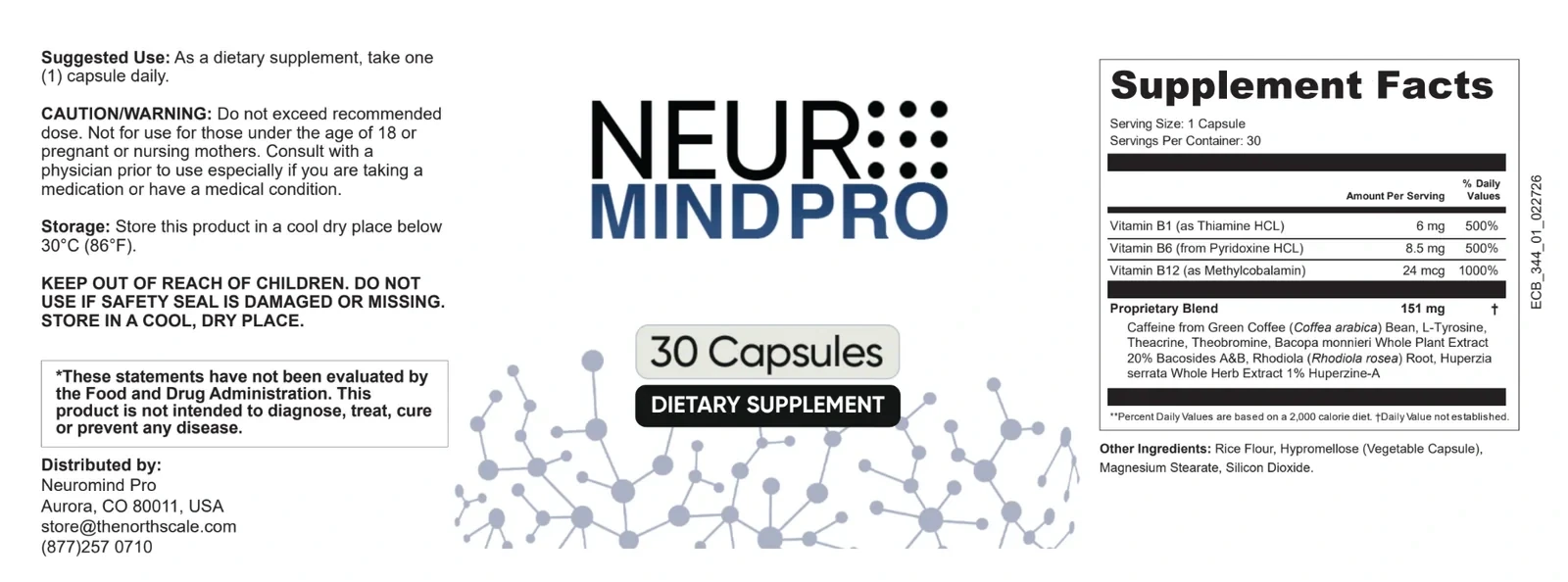
- Serving size is one capsule. Servings per container: 30.
- Vitamin B1 (as thiamine HCL) 6 mg, 500% Daily Value.
- Vitamin B6 (from pyridoxine HCL) 8.5 mg, 500% Daily Value.
- Vitamin B12 (as methylcobalamin) 24 mcg, 1000% Daily Value.
- Proprietary Blend 151 mg. It is a ceiling for each name, not an allocation.
- Other ingredients: rice flour, hypromellose (vegetable capsule), magnesium stearate, silicon dioxide.
How many ingredients are on the Neuromind Pro label?
Ten substances are named. Four rows are printed on the panel: three vitamins and one blend. The blend row hides seven more names behind one figure. Counted that way, you get ten actives, of which three carry their own milligrams.
This is the single most important fact about the label. Many pages online talk as if every ingredient had a printed amount. Here, three do and seven do not.
What does the Supplement Facts panel print?
| Row | Amount per serving | % Daily Value |
|---|---|---|
| Vitamin B1 (as Thiamine HCL) | 6 mg | 500% |
| Vitamin B6 (from Pyridoxine HCL) | 8.5 mg | 500% |
| Vitamin B12 (as Methylcobalamin) | 24 mcg | 1000% |
| Proprietary Blend | 151 mg | † |
Serving size: 1 capsule. Servings per container: 30. The dagger means no Daily Value is established for the blend.
Hold your own bottle against these four rows. They should read the same, row for row. If the bottle in your hand differs, set it aside and call the order desk on +1 (877) 257-0710.
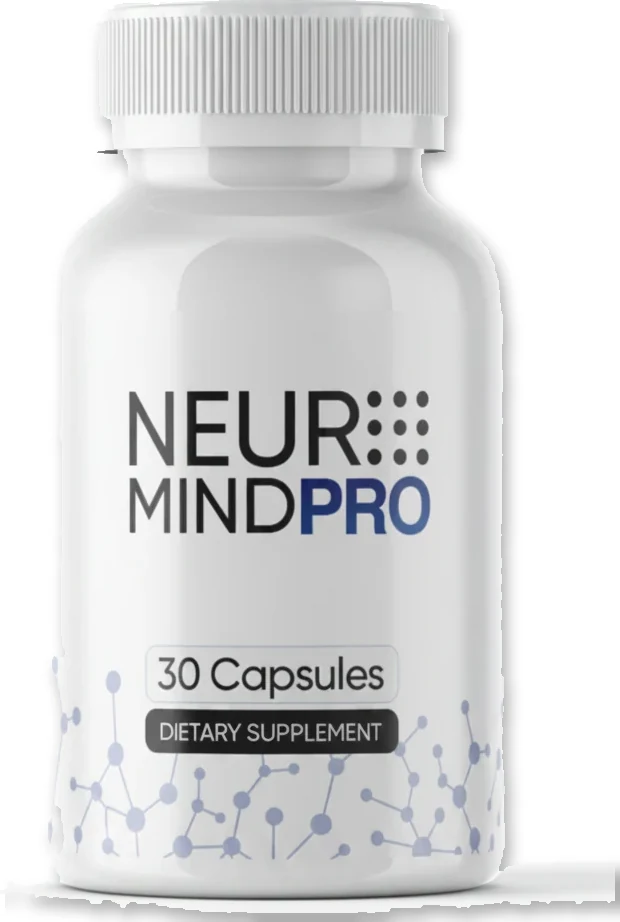
Check the bottle against the panel.
The official page prints the same panel, plus the pack sizes and the 60-day guarantee.
See today’s price and guaranteeGetneuromind earns when an order is placed through this website. How the desk earns, in its own words.
What is inside the 151 mg blend?
Seven names, in the order the label prints them. None has a published amount.
- Caffeine from Green Coffee (Coffea arabica) Bean
- L-Tyrosine
- Theacrine
- Theobromine
- Bacopa monnieri Whole Plant Extract, 20% bacosides A&B
- Rhodiola rosea Root
- Huperzia serrata Whole Herb Extract, 1% huperzine-A
Because the blend weighs 151 mg in total, no single name can weigh more than 151 mg, and six of the seven must weigh less. A product page that gives a milligram figure for any one of them is not reading it off this label. That includes figures for caffeine: green coffee bean is the source, and the amount is not printed.
What do the 20% and 1% on the extracts mean?
Two blend names carry a percentage. A standardised extract is measured against a marker compound, so the percentage tells you how much of the extract weight is the part researchers counted.
Bacopa is a whole plant extract at 20% bacosides A and B. That compound family is what its trials were built around. Huperzia serrata is listed at 1% huperzine-A, and that divides cleanly: 100 mg of extract carries 1 mg of huperzine-A. The trial range of 0.4 to 0.8 mg would need 40 to 80 mg of extract.
That arithmetic shows why huperzine-A is the one name whose studied amount could sit comfortably inside a 151 mg blend. It also shows why its published amount matters. The label does not give one. Huperzine-A is a reversible acetylcholinesterase inhibitor, which is the same mechanism class as prescription dementia drugs, so if you take such a medicine speak to your prescriber first.
What else is inside a Neuromind Pro capsule?
Four names sit under the heading Other Ingredients. Each has a manufacturing job and none is aimed at your attention.
| Other ingredient | Its job |
|---|---|
| Rice flour | Bulking agent that fills the shell evenly |
| Hypromellose | The shell itself, a plant cellulose rather than gelatin |
| Magnesium stearate | Flow agent so powder moves evenly through the machine |
| Silicon dioxide | Anti-caking agent for a fine powder |
No sugar, sweetener or flavouring appears on the ingredient statement.
Why does the product graphic show only six ingredients?
The seller’s ingredient artwork pictures six: thiamine, vitamin B6, vitamin B12, caffeine from green coffee bean, L-tyrosine and theacrine. The Supplement Facts panel names four more inside the blend: theobromine, bacopa, rhodiola and huperzia.
The seller’s own pack summary lists only the six pictured names. Where the artwork and the panel differ, the printed panel decides. It is the legal ingredient statement printed on the bottle that arrives at your door. Every amount and caution on this website is read from it.
Where do these facts come from?
These are the sources for the dose and safety notes tied to individual names. They concern single ingredients.
- Teixeira J, Pereira I, Castanho M, et al. What is the impact of thiamine deficiency on cognitive function in patients with alcohol use disorder? A systematic review. Eur J Intern Med. 2025;134:59-65. https://pubmed.ncbi.nlm.nih.gov/39818490/
- EFSA Panel on Nutrition, Novel Foods and Food Allergens. Scientific opinion on the tolerable upper intake level for vitamin B6. EFSA J. 2023;21(5):e08006. https://pubmed.ncbi.nlm.nih.gov/37207271/
- Malouf R, Grimley Evans J. The effect of vitamin B6 on cognition. Cochrane Database Syst Rev. 2003;(4):CD004393. https://pubmed.ncbi.nlm.nih.gov/14584010/
- Markun S, Gravestock I, Jager L, et al. Effects of vitamin B12 supplementation on cognitive function, depressive symptoms, and fatigue: a systematic review, meta-analysis, and meta-regression. Nutrients. 2021;13(3). https://pubmed.ncbi.nlm.nih.gov/33809274/
- McLellan TM, Caldwell JA, Lieberman HR. A review of caffeine's effects on cognitive, physical and occupational performance. Neurosci Biobehav Rev. 2016;71:294-312. https://pubmed.ncbi.nlm.nih.gov/27612937/
- Wikoff D, Welsh BT, Henderson R, et al. Systematic review of the potential adverse effects of caffeine consumption in healthy adults, pregnant women, adolescents, and children. Food Chem Toxicol. 2017;109(Pt 1):585-648. https://pubmed.ncbi.nlm.nih.gov/28438661/
- Jongkees BJ, Hommel B, Kuhn S, et al. Effect of tyrosine supplementation on clinical and healthy populations under stress or cognitive demands: a review. J Psychiatr Res. 2015;70:50-57. https://pubmed.ncbi.nlm.nih.gov/26424423/
- Kuhman DJ, Joyner KJ, Bloomer RJ. Cognitive performance and mood following ingestion of a theacrine-containing dietary supplement, caffeine, or placebo by young men and women. Nutrients. 2015;7(11):9618-9632. https://pubmed.ncbi.nlm.nih.gov/26610558/
- Baggott MJ, Childs E, Hart AB, et al. Psychopharmacology of theobromine in healthy volunteers. Psychopharmacology (Berl). 2013;228(1):109-118. https://pubmed.ncbi.nlm.nih.gov/23420115/
- Kongkeaw C, Dilokthornsakul P, Thanarangsarit P, et al. Meta-analysis of randomized controlled trials on cognitive effects of Bacopa monnieri extract. J Ethnopharmacol. 2014;151(1):528-535. https://pubmed.ncbi.nlm.nih.gov/24252493/
- Hung SK, Perry R, Ernst E. The effectiveness and efficacy of Rhodiola rosea L.: a systematic review of randomized clinical trials. Phytomedicine. 2011;18(4):235-244. https://pubmed.ncbi.nlm.nih.gov/21036578/
- Li J, Wu HM, Zhou RL, et al. Huperzine A for Alzheimer's disease. Cochrane Database Syst Rev. 2008;(2):CD005592. https://pubmed.ncbi.nlm.nih.gov/18425924/
Frequently asked questions
What are the ingredients in Neuromind Pro?
Vitamin B1, B6 and B12 with printed amounts, plus a 151 mg proprietary blend of caffeine from green coffee bean, L-tyrosine, theacrine, theobromine, bacopa, rhodiola and huperzia. Rice flour, hypromellose, magnesium stearate and silicon dioxide are the other ingredients.
How much caffeine is in Neuromind Pro?
Not published. The caffeine is inside the 151 mg blend shared by seven ingredients, so it is below 151 mg.
Is the Neuromind Pro capsule vegetarian?
The shell is hypromellose, a plant cellulose, and no gelatin is listed. Consult the label on your own bottle for your own needs.
Why are some amounts not published?
The label uses a proprietary blend, which is allowed labelling. It declares the total weight and leaves the split between the named ingredients to the formulator.
What does 1% huperzine-A mean?
The extract is standardised so that 1% of its weight is huperzine-A. That is 1 mg in every 100 mg of extract. How much extract is in a capsule is not published.
Does Neuromind Pro contain sugar or sweetener?
No sugar, sweetener or flavouring appears on the ingredient statement.
Our view
Our view is that the label is good where it prints numbers and thin where it does not. Three vitamin amounts are clear and checkable. The blend total is a real figure you can reason from. The split is the part you cannot see.
The ingredient choices themselves are conventional for this category. Caffeine and bacopa have the better research records, and both are here. What is missing is the dose of each, and that is what decides whether a name does anything.
If you are comfortable buying a blend, this is a readable one. If you need exact amounts for every ingredient, pick a label that prints them.
Neuromind Pro is a dietary supplement. It is not FDA approved, and no supplement is. These statements have not been evaluated by the Food and Drug Administration. This product is not intended to diagnose, treat, cure or prevent any disease. Check the ingredient list against any medicine or allergy you have, and ask a doctor or pharmacist if you are unsure.
Ten names, one capsule a day.
If the label suits you, the checkout shows today’s price. Keep the order email until you have compared your bottle.
See today’s price and guaranteeGetneuromind earns when an order is placed through this website. How the desk earns, in its own words.