Neuromind Pro Official Website › How it works
How it worksHow Does Neuromind Pro Work? Three Pathways Explained
Neuromind Pro works through three separate routes in one capsule.
Caffeine, theacrine and theobromine act on adenosine receptors the same day. L-tyrosine and three B vitamins supply the raw material for dopamine and noradrenaline, while bacopa, rhodiola and huperzine-A work over weeks.
See how to take it.
Three routes, two clocks, and what each one was measured doing.
What happens in the hours after a Neuromind capsule?
One part of this panel reports quickly. The rest of it has not started yet.
Swallowing the capsule starts two processes that have nothing to do with each other. The shell opens in the stomach, the powder disperses, and the stimulant compounds begin to be absorbed. That part is quick and it is the only part of this formula with a same-morning story.
Caffeine is the compound driving it. It is structurally similar enough to adenosine to sit in adenosine's receptors without switching them on, and adenosine is the molecule that accumulates through a waking day and makes you feel like stopping. Block the signal and the fatigue is postponed rather than erased, which is why the review of caffeine and performance reports alertness and reaction time moving while the underlying tiredness stays where it was.
The other eight named substances do nothing you can perceive in that window. The vitamins enter a pool your body has been managing for years. Tyrosine joins the amino acids from your breakfast. The three botanicals are measured in weeks by every trial that has studied them. A first day on this capsule is a report on its stimulant quarter and nothing else.
Which pathways does Neuromind Pro act on?
Three unrelated routes sitting on one label, and it helps to keep them apart.
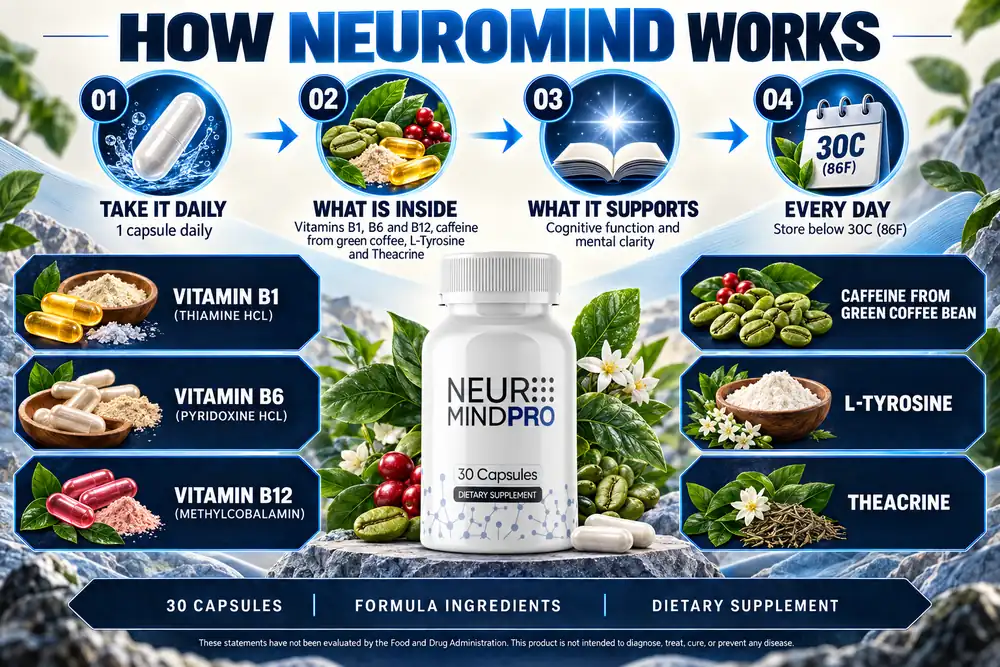
There is no single mechanism to describe here, and a page that invented one would be inventing it. What the panel holds is three groups of substances that reach cognition by unrelated routes and on unrelated timescales. Taking them one at a time is the only honest way to lay it out.
Blocking the tiredness signal
Caffeine, theacrine and theobromine. These act on adenosine signalling and related targets, and their effects arrive the same day. Caffeine carries the evidence, theacrine is its close relative with a smaller literature, and theobromine is the mild one that chocolate supplies.
Supplying the material a transmitter is built from
L-tyrosine plus thiamine, vitamin B6 and vitamin B12. Tyrosine is the precursor that becomes dopamine and then noradrenaline, and the B vitamins are cofactors in the enzyme steps around that conversion. This route has the cleanest biochemistry on the panel and the most conditional payoff.
Working slowly on the brain's own chemistry
Bacopa monnieri, Rhodiola rosea and huperzine-A. None of the three is a stimulant. Two of them were studied over weeks to months, and the third acts on an enzyme in the cholinergic system at microgram amounts. They share a group only because they are all slow.
How does the stimulant side of Neuromind Pro work?
What blocking an adenosine receptor does, and what it does not do.
Adenosine builds up in the brain across a waking day and is one of the signals that pushes you toward sleep. Caffeine occupies the receptors that signal reads, so the message arrives muted. Nothing is added to your reserves by this: the tiredness is deferred and it collects the debt later.
That is also why caffeine does its most impressive work in people who are short of sleep. A meta-analysis of caffeine after sleep loss found meaningful recovery of cognitive, physical and driving performance in exactly that state, which is a narrower and more interesting claim than a general enhancer.
Theacrine reaches overlapping targets with a different profile and a much smaller evidence base, and theobromine is the weakest of the three on its own, contributing most alongside caffeine rather than instead of it. The trial figures for both sit on the ingredients page, beside every other name on the panel.
How does Neuromind Pro supply raw material?
A precursor and three cofactors, and the conditions that decide whether they matter.
Dopamine and noradrenaline are built, not stored indefinitely, and the assembly line starts at tyrosine. Under ordinary conditions supply is not the limiting step, which is the single most important fact about this pathway and the one marketing copy usually skips.
It becomes the limiting step under load. The review of the tyrosine trials describes the pattern precisely: benefit where cold, noise, sleep loss or acute pressure are draining those transmitters faster than they are being replaced, and no benefit in a rested adult sitting in a quiet room. That makes tyrosine a situational ingredient rather than a daily one.
The three B vitamins work one step across from that. They are cofactors in the enzymes that handle amino acids and transmitters, so their contribution is real and their measurable effect depends on whether the cofactor was ever scarce. A 2025 meta-analysis of B vitamins and cognition in older adults found the average benefit very small, which is what you would expect from a population mostly not deficient.
The practical reading is simple enough. If your diet, age or medication has left you short of B12 or thiamine, this quarter of the panel has something to do. If it has not, the vitamins are insurance, and the benefits page says so in the same words.
How do the Neuromind botanicals act?
Three slow ingredients that have almost nothing else in common.
These three are the slow half of the formula, and each of them works differently from the other two.
Bacopa monnieri
The mechanism is still argued over, which is worth saying rather than picking a favourite theory. What is settled is the shape of the effect: the meta-analysis admitted only trials of twelve weeks or more, and speed of attention was the domain that moved. It behaves like something that accumulates, not something that acts.
Rhodiola rosea
Studied as an anti-fatigue botanical rather than a memory one, and the outcomes are tiredness and perceived exertion. A systematic review of eleven placebo-controlled trials called the results possible rather than established, and pointed at the thinness of independent replication as the reason.
Huperzine-A
The one genuinely pharmacological mechanism on this panel. It reversibly inhibits acetylcholinesterase, the enzyme that clears acetylcholine from a synapse, so the transmitter lingers. Cochrane found the evidence inadequate to recommend it while noting that it is unambiguously active in microgram amounts.
Grouping them by speed is useful; treating them as interchangeable is not. Bacopa asks for months, rhodiola's trials report in weeks, and huperzine-A acts on an enzyme from the first capsule even though what that produces in a healthy adult is exactly what the research has been unable to establish.
Why does Neuromind Pro run on two clocks?
Same capsule, two completely different reporting schedules.
| Ingredient group | When its own trials measured | What you would notice |
|---|---|---|
| Caffeine, theacrine, theobromine | Within hours of a single dose | Whatever this capsule does on day one, it does through this group |
| L-tyrosine | Same day, but only under cold, noise, sleep loss or acute stress | Nothing on an ordinary desk day; the trials are clear about the condition |
| Thiamine, B6, B12 | Weeks to months, and only where a shortfall existed | Nothing perceptible unless a blood test would have found something |
| Rhodiola rosea | Typically several weeks of daily dosing | A change in how heavy effort feels, if it arrives at all |
| Bacopa monnieri | Twelve weeks minimum in every trial the meta-analysis kept | Nothing before then, which is the commonest disappointment on this formula |
| Huperzine-A | Trials ran sixteen weeks or longer at fixed amounts | Not a subjective effect anyone reports reliably |
The left column is what the published research on these ingredients measured at the doses it used. It describes the substances, not a promise about this capsule.
Two clocks is the practical summary. One reports by lunchtime and one reports in the second month, and a buyer who judges the formula at the first clock has judged a quarter of it. That is the whole argument behind the results timeline and behind the 60-day window.
What the 151 mg total means for how Neuromind Pro works
Mechanisms are real at a dose, and this is where the dose gets discussed.
Everything above describes mechanisms, and every one of those mechanisms is genuine. A mechanism only becomes an effect at a dose, and this is the section where that distinction gets its due.
The 7 substances in the blend share 151 mg between them. Six of the seven have published trial doses larger than that total on their own: caffeine's alertness work sits above 200 mg, theacrine's trials run 125 to 400 mg, theobromine's ran 250 to 1,000 mg, bacopa's 300 mg a day, rhodiola's 400 to 576 mg, and tyrosine's are measured in grams. Not one of those could fit inside 151 mg even if it took the whole blend.
Huperzine-A is the seventh and it is the exception, at 0.4 to 0.8 mg a day in the trials. It fits with room to spare, and it happens to be the only substance on the panel that acts like a drug class rather than a nutrient.
So the honest position on mechanism is this. The routes described above are the routes these ingredients take, at the amounts the researchers used. What portion of each route this capsule opens depends on a split the label leaves to the formulator, and the ingredients page sets the whole comparison out ingredient by ingredient.
What Neuromind Pro cannot do, mechanically
Five things no arrangement of these ingredients is able to deliver.
- It cannot replace sleep. Adenosine blockade postpones a signal; it does not restore what sleep does, and the debt is still there in the evening.
- It cannot raise a normal vitamin level into an advantage. Repletion is a ceiling, not a slope, which is why the B vitamin trials in people who are not deficient come back flat.
- It cannot treat, prevent or reverse a memory condition. No dietary supplement may claim that, and the systematic review of cognitive supplement ingredients found the supportable list much shorter than the category's marketing.
- It cannot act faster than its slowest part. Bacopa's own trials will not report before twelve weeks whatever the rest of the capsule is doing.
- It cannot tell you how much of each ingredient you took, which is why the amount question is answered as a ceiling rather than a number.
Does Neuromind Pro work differently for different people?
Four variables that move the result more than anything on the panel does.
Four things change the answer more than the formula does, and all four are knowable before you buy.
How much caffeine you already drink
A daily four-cup habit has already adjusted the receptors the stimulant quarter of this capsule acts on. The same capsule lands differently on somebody who drinks nothing, and it is the commonest reason two people describe the same product in opposite terms.
How much sleep you are short of
Caffeine's biggest measured effects arrive in sleep-deprived people, which the sleep-loss meta-analysis shows directly. Well-rested, the same dose has less to correct and less room to impress.
Whether you were short of a B vitamin
This decides whether three of the ten rows do anything at all. Age, a vegan diet, long-term metformin or acid-suppressing medicine all raise the odds, and a blood test answers it in a way no supplement label can.
Your own biology
Tyrosine's effect in one randomised trial split by dopamine receptor genotype, with some participants improving and others not. That kind of variation is normal in this category and it is why an eight-week trial of your own beats any general claim.
How would you tell whether Neuromind Pro is doing anything?
Five steps, and the first one costs a week and nothing else.
Pick one thing you can actually measure
Minutes before the first distraction, pages read before your attention goes, or how the fourth hour of a working afternoon feels on a scale of one to five. A single concrete measure beats a general impression, because a general impression is what marketing is designed to move.
Write down a week of it before the first capsule
Without a baseline every judgement afterwards is a comparison against memory, and memory is the thing under test. One ordinary week is enough.
Hold your coffee steady
If you cut two cups the morning you start, you have run two experiments at once and neither will give you an answer. Keep the rest of the day the same for the first fortnight.
Check again at four weeks, and then at eight
The stimulant quarter has reported long before the first checkpoint. The second one is where rhodiola's trials sit and where bacopa is finally getting close to the twelve weeks its own research demands. 4–8 weeks is the distributor's own figure for the common wait.
Decide while the window is still open
The guarantee runs 60 days from purchase rather than from your first capsule, so the decision and the refund window should be set to the same clock. The guarantee page has the steps.
Sources for how Neuromind Pro works
The trials and reviews behind each pathway described above.
- McLellan TM, Caldwell JA, Lieberman HR. A review of caffeine's effects on cognitive, physical and occupational performance. Neurosci Biobehav Rev. 2016;71:294-312. PMID 27612937. https://pubmed.ncbi.nlm.nih.gov/27612937/
- Irwin C, Khalesi S, Desbrow B, et al. Effects of acute caffeine consumption following sleep loss on cognitive, physical, occupational and driving performance: A systematic review and meta-analysis. Neurosci Biobehav Rev. 2020;108:877-888. PMID 31837359. https://pubmed.ncbi.nlm.nih.gov/31837359/
- Jongkees BJ, Hommel B, Kuhn S, et al. Effect of tyrosine supplementation on clinical and healthy populations under stress or cognitive demands--A review. J Psychiatr Res. 2015;70:50-7. PMID 26424423. https://pubmed.ncbi.nlm.nih.gov/26424423/
- Colzato LS, Steenbergen L, Sellaro R, et al. Effects of l-Tyrosine on working memory and inhibitory control are determined by DRD2 genotypes: A randomized controlled trial. Cortex. 2016;82:217-224. PMID 27403851. https://pubmed.ncbi.nlm.nih.gov/27403851/
- Berg J, Grant R, Siervo M, et al. Efficacy of B Vitamin Supplementation on Global Cognitive Function in Older Adults: A Systematic Review and Meta-analysis. Nutr Rev. 2025;83(12):2256-2267. PMID 40966571. https://pubmed.ncbi.nlm.nih.gov/40966571/
- Kongkeaw C, Dilokthornsakul P, Thanarangsarit P, et al. Meta-analysis of randomized controlled trials on cognitive effects of Bacopa monnieri extract. J Ethnopharmacol. 2014;151(1):528-35. PMID 24252493. https://pubmed.ncbi.nlm.nih.gov/24252493/
- Hung SK, Perry R, Ernst E. The effectiveness and efficacy of Rhodiola rosea L.: a systematic review of randomized clinical trials. Phytomedicine. 2011;18(4):235-44. PMID 21036578. https://pubmed.ncbi.nlm.nih.gov/21036578/
- Li J, Wu HM, Zhou RL, et al. Huperzine A for Alzheimer's disease. Cochrane Database Syst Rev. 2008;(2):CD005592. PMID 18425924. https://pubmed.ncbi.nlm.nih.gov/18425924/
- Crawford C, Boyd C, Deuster PA. Dietary Supplement Ingredients for Optimizing Cognitive Performance Among Healthy Adults: A Systematic Review. J Altern Complement Med. 2021;27(11):940-958. PMID 34370563. https://pubmed.ncbi.nlm.nih.gov/34370563/
Order Neuromind Pro and run the eight-week test
One capsule a day, 30 to a bottle, and a 60-day window that is roughly as long as a fair trial of the slow half of this panel.
Packs from $158 · six bottles for $294 · 60-day money-back guarantee
Order Neuromind Pro On The Official WebsiteOne capsule a day · 30 per bottle · lot NEU-26/GE-6907