Neuromind Pro Official Website › Ingredients
IngredientsNeuromind Pro Ingredients: The Ten Names on the Label
Neuromind Pro contains ten ingredients: three B vitamins and a 151 mg blend of seven more.
The vitamins are thiamine 6 mg, vitamin B6 8.5 mg and vitamin B12 24 mcg. The blend holds caffeine from green coffee, L-tyrosine, theacrine, theobromine, bacopa, rhodiola and huperzine-A.
Every name on the panel, what it is, and the amount the published research put behind it.
What does the Neuromind Pro label name?
Four printed rows, and seven more names folded into the last of them.
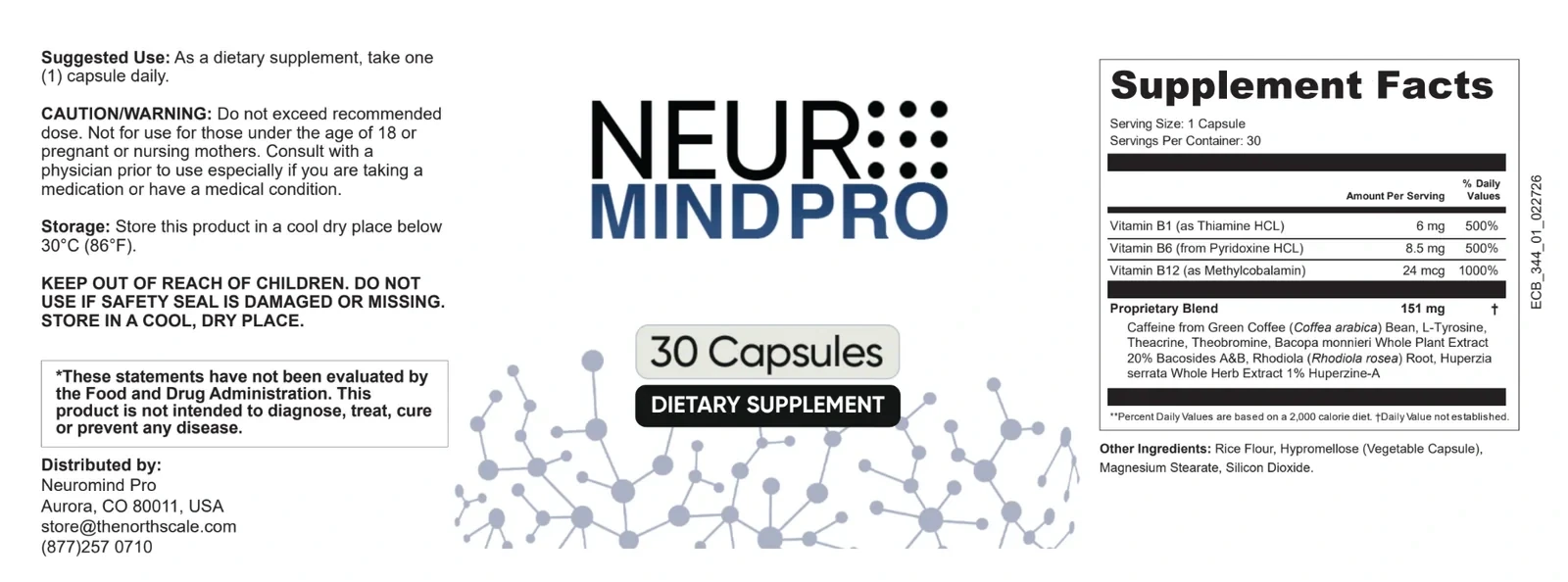
| Row | Amount per capsule | % Daily Value |
|---|---|---|
| Vitamin B1 (as Thiamine HCL) | 6 mg | 500% |
| Vitamin B6 (from Pyridoxine HCL) | 8.5 mg | 500% |
| Vitamin B12 (as Methylcobalamin) | 24 mcg | 1000% |
| Proprietary Blend | 151 mg | † |
Serving size one capsule. Servings per container 30. Transcribed from the printed label artwork.
Below the blend line the label sets out the seven names it covers, in this order: Caffeine from Green Coffee (Coffea arabica) Bean, L-Tyrosine, Theacrine, Theobromine, Bacopa monnieri, Rhodiola rosea Root, Huperzia serrata.
Four printed rows, then, and ten named substances. Three carry their own milligrams. The other 7 carry one shared figure of 151 mg, which is their combined weight and therefore the largest any single one of them could be. Those ten split three ways by job, which is how the mechanism page takes them.
What are the ten Neuromind Pro ingredients?
What each substance is, and the figure the published work ran at.
One card each, in label order. The figure beside every name is the amount that the research on it actually used, except for the three vitamins, where the label prints its own number and there is nothing to convert.
Vitamin B1
as thiamine HCl6 mg, printedWhat cells spend to turn carbohydrate into usable energy, and nerve tissue is an expensive customer. The cognitive benefit tracks a shortfall rather than a surplus: a 2025 systematic review found lower thiamine alongside poorer attention and memory in alcohol use disorder, while Cochrane found too little to say in Alzheimer's disease. No upper intake has been set for thiamine, so 6 mg is a small figure wearing a large percentage.
Vitamin B6
from pyridoxine HCl8.5 mg, printedA cofactor dozens of enzymes borrow, including the ones that finish dopamine, serotonin and noradrenaline. The machinery is real; what the trials add is that topping it up in people never short moved nothing measurable in the Cochrane review of B6 and cognition. It is also the one row carrying a ceiling: EFSA put the adult tolerable upper intake at 12 mg a day, so one capsule uses seven-tenths of a day's headroom.
Vitamin B12
as methylcobalamin24 mcg, printedThe row worth a blood test rather than a guess. Absorption falls with age and with long-running metformin or acid-suppressing medicine, and a shortfall shows up in thinking, balance and mood. Correct it and the picture improves. Add it to somebody already replete and the trials fall silent, which is what a meta-analysis of 6,276 participants reported across every cognitive subdomain. 24 mcg is generous, safe, and worth what your starting point makes it worth.
Caffeine from green coffee bean
Coffea arabicaTrials: 40–300 mgThe compound most likely to produce something a first-time user can feel, and the one with the deepest human record. It occupies adenosine receptors, holding off the drift toward drowsiness. The major review puts the useful window between roughly 40 mg and 300 mg, clearest above about 200 mg, and up to 400 mg a day is without adverse effect in healthy adults per a systematic review of caffeine safety.
L-Tyrosine
Trials: 2 g a dayAn amino acid you already eat in any protein, and the starting block the body works up into dopamine and noradrenaline. Its trials are specific about when that matters: the review of the tyrosine literature finds an effect while those transmitters are drained by cold, noise, sleep loss or acute pressure, and little outside it. Cadets on a combat course improved on 2 g a day, and one trial found the effect size tracked a dopamine receptor genotype. Every dose there is written in grams.
Theacrine
Trials: 125–400 mg a dayA purine alkaloid from kucha tea, close enough to caffeine in shape to reach some of the same receptors without behaving identically. What gets reported is energy rather than recall: volunteers in the cognition and mood trial rated themselves higher on energy and lower on lethargy than on caffeine or placebo. Eight weeks at 200 to 300 mg a day moved no clinical marker and produced no habituation, the reverse of the claim usually attached to it.
Theobromine
Trials: 250–1,000 mgCocoa's own methylxanthine, and much the mildest of the three stimulant compounds here. The largest human study ran 250, 500 and 1,000 mg and found thin subjective effects at the bottom and worse mood with a quicker pulse at the top. An older head-to-head against caffeine had 560 mg of theobromine failing to match 178 mg of caffeine on energy and alertness. Its role is as caffeine's companion at chocolate-like amounts.
Bacopa monnieri
whole plant extract, 20% bacosides A&BTrials: 300 mg a day, 12 weeksThe best cognitive record on this label, and much the longest fuse. The meta-analysis set twelve weeks as its entry requirement, and what moved inside that window was speed of attention rather than recall. A twelve-week randomised trial in older adults ran 300 mg a day of standardised extract, though a 2025 trial in 101 healthy adults separated from placebo on nothing. Stomach discomfort is its commonest complaint.
Rhodiola rosea
rootTrials: 400–576 mg a dayAn arctic root studied for tiredness and for how heavy effort feels, rather than for memory. A systematic review of eleven placebo-controlled trials reported possible benefit and named its own weakness in the same breath: individual studies have rarely been repeated independently. The amounts are specific and large. The stress-related fatigue trial used 576 mg a day of standardised extract and an open-label burnout study used 400 mg.
Huperzia serrata
whole herb extract, 1% huperzine-ATrials: 0.4–0.8 mg a dayThe outlier, and the reason the blend line is worth thinking about at all. Huperzine-A is a reversible acetylcholinesterase inhibitor: it slows the enzyme that clears acetylcholine, the lever prescription dementia medicines pull. It is active in micrograms, so its studied amount is the only one here a 151 mg blend could hold several times over. The efficacy record is thinner than the reputation: the best-conducted Western trial gave 200 mcg twice daily for sixteen weeks without shifting its primary outcome, and a later meta-analysis judged most trials at high risk of bias.
What do the Neuromind extract percentages mean?
Two numbers on the panel do arithmetic you can follow all the way through.
Two blend entries carry a percentage, and those are the most useful arithmetic on the bottle. A standardised extract is measured against a marker compound, so the percentage says how much of the extract weight is the part anybody studied.
Bacopa monnieri is a whole plant extract at 20% bacosides A and B, the compound family its cognitive trials were built around, so a fifth of the extract weight is the fraction being counted. Those trials dosed 300 mg a day and ran twelve weeks before measuring anything.
Huperzia serrata is listed at 1% huperzine-A, and that divides cleanly. A hundred milligrams of extract carries one milligram of huperzine-A, so the trial range of 0.4 to 0.8 mg needs 40 to 80 mg of extract.
Forty to eighty milligrams of a 1% extract is an ordinary slice of 151 mg, so huperzine-A is the one entry that could plausibly sit at a studied dose. It is also the one acting like a drug class, which is why it has a section of its own.
How much of each ingredient does Neuromind Pro hold?
One total, 7 names, and the trial figures lined up beside it.
151 mg is what those 7 weigh on a scale together, which makes it a ceiling on every one of them at once: no single name can exceed 151 mg and six have to sit well below it. Set that against the amounts the researchers poured out.
Two of those gaps are worth restating in units. Tyrosine's cold-exposure work dosed 150 mg per kilogram, close to 10 g in a 70 kg adult, so the whole blend is on the order of a hundredth of one such dose. Rhodiola's fatigue trial ran 576 mg a day, nearly four blends.
Huperzine-A is the exception. Between 0.4 and 0.8 mg leaves 150 mg of the 151 mg still unspoken for, so it is the one substance that could comfortably sit at a researched amount, and the only one working through an enzyme rather than a nutrient pathway. How the 7 divide the total is the formulator's decision.
Vitamin B6 at 8.5 mg sits comfortably under EFSA's 12 mg adult upper intake on its own. It stops being comfortable when a B-complex, a fortified cereal and an energy drink join it before lunch. Sustained high pyridoxine intake causes a sensory neuropathy, the effect that set the limit, and it has been reported after ordinary daily multivitamin use. Read your other labels once and the question is settled.
Which Neuromind Pro ingredients does the product graphic leave out?
Six names on the marketing art, ten on the panel, and the panel is what ships.
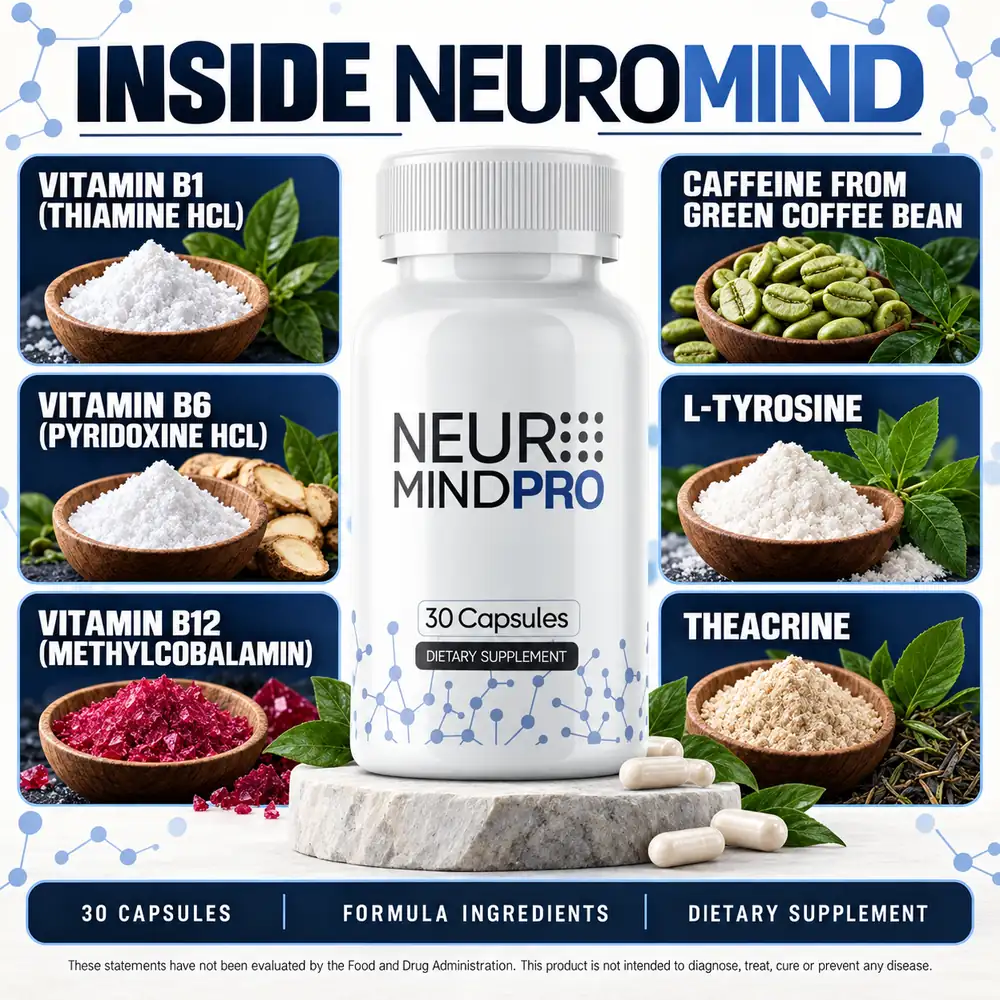
The supplier's ingredient artwork pictures six: thiamine, vitamin B6, vitamin B12, caffeine from green coffee bean, L-tyrosine and theacrine. The Supplement Facts panel carries four more inside the blend line, and they are theobromine, Bacopa monnieri, Rhodiola rosea and Huperzia serrata.
Where the artwork and the panel differ, the panel decides: it is the legal ingredient statement, printed on the bottle that arrives at your door, and every amount and caution on this website is read off it.
That is worth one mention and no more. The four extra names are on the label, in the list above, and two carry the standardisation percentages worked through earlier. Hold your own bottle against the transcription on this site and the two should read the same row for row.
Which Neuromind Pro ingredient has the strongest evidence?
The ten sorted by how much human research stands behind them, strongest first.
| Ingredient | What the strongest studies measured | How solid the record is |
|---|---|---|
| Caffeine | Alertness, vigilance and reaction time, across dozens of trials | Much the strongest name here |
| Bacopa monnieri | Speed of attention at twelve weeks or longer | Good, with one 2025 null result |
| Vitamin B12 and B1 | Cognition in people genuinely short of them | Strong for a shortfall, flat without one |
| L-Tyrosine | Working memory under cold, noise or sleep loss | Narrow, replicated, dosed in grams |
| Rhodiola rosea | Fatigue and perceived exertion | Promising, barely replicated |
| Theacrine | Self-rated energy, plus an eight-week safety run | Small, and clustered around one branded ingredient |
| Huperzine-A | Cognitive scores in dementia trials, mostly from China | Active, and the evidence judged inadequate |
| Vitamin B6 | No cognitive effect without a deficiency | Settled, and the one row with an upper intake |
| Theobromine | Mood and heart rate between 250 and 1,000 mg | Weakest of the three stimulants alone |
Ranked on the human evidence for each substance at the dose those studies used, which is a ranking of research rather than of this capsule.
A systematic review of cognitive supplement ingredients in healthy adults tested the category's marketing against its trials and found the supportable list far shorter than the shelf, and a review of 103 memory supplements sold in U.S. pharmacies arrived in the same place from the other direction. Caffeine and bacopa come out of both better than most, and both are here. The selection of names is good; how seven of them share one total is the separate question the dosage section answers.
How much caffeine is in Neuromind Pro?
A source you can read on the label, and a ceiling you can reason from.
The source is printed and the milligrams sit inside the blend, so the accurate answer is a range with one hard edge: nothing above 151 mg, because that is the weight of the whole blend, and meaningfully below it, because six other substances share the same total.
Green coffee bean means the caffeine is drawn from unroasted Coffea arabica, and unroasted beans hold less caffeine by weight than roasted ones.
So treat the capsule as an addition to your usual coffee rather than a replacement for it. And if your day already runs near the 400 mg that the caffeine safety review describes as without adverse effect in healthy adults, that is the figure to do the arithmetic against, since supplemental caffeine raises blood pressure in proportion to the dose. How to take it sets out the counting in practice.
What else is inside a Neuromind Pro capsule?
Four names, four manufacturing jobs, and none of them aimed at your attention.
Four names sit below the panel under Other Ingredients, each with a manufacturing job rather than a cognitive one.
Rice flour
The bulking agent. A shell has a fixed internal volume and the actives weigh under 200 mg together, so something fills the rest of it evenly. Rice flour is the usual choice where wheat is being avoided.
Hypromellose
The shell itself, made from plant cellulose rather than gelatin. That one word is what makes the capsule suitable for a vegetarian routine.
Magnesium stearate
A flow agent, keeping powder moving evenly through the encapsulating machine so all thirty capsules get the same fill weight.
Silicon dioxide
An anti-caking agent, stopping a fine powder clumping in humid air between the factory and your kitchen.
No sugar, sweetener or flavouring appears anywhere on that list, because a capsule needs none of the three.
Neuromind Pro ingredient questions
Which Neuromind ingredient is the strongest stimulant?
Caffeine, by a distance. Theacrine is milder, theobromine milder again, and all three sit on the same panel, which is why the capsule belongs in the morning.
Is huperzine-A something to take every day?
It is a reversible acetylcholinesterase inhibitor, which is a pharmacological mechanism rather than a nutritional one. If you take a prescribed cholinesterase inhibitor or an anticholinergic medicine, that overlap is the conversation to have with your prescriber first. Who it is for sets out the full position.
Why do seven amounts sit behind one blend total?
A proprietary blend is permitted labelling in the United States: the total weight is declared and the split between the named ingredients is left to the formulator. What a buyer gets from it is a ceiling. No single one of the seven can weigh more than 151 mg.
What does Coffea arabica mean on the label?
It is the coffee species the green bean extract is taken from. Green means unroasted, and unroasted beans carry less caffeine by weight than the roasted beans in your cafetiere.
Sources for the Neuromind Pro ingredient list
Every study named above, in the order the panel lists the ingredient it belongs to.
- Teixeira J, Pereira I, Castanho M, et al. What is the impact of thiamine deficiency on cognitive function in patients with alcohol use disorder? - A systematic review. Eur J Intern Med. 2025;134:59-65. PMID 39818490. https://pubmed.ncbi.nlm.nih.gov/39818490/
- Rodriguez-Martin JL, Qizilbash N, Lopez-Arrieta JM. Thiamine for Alzheimer's disease. Cochrane Database Syst Rev. 2001;(2):CD001498. PMID 11405995. https://pubmed.ncbi.nlm.nih.gov/11405995/
- EFSA Panel on Nutrition, Novel Foods and Food Allergens (NDA); Turck D, Bohn T, Castenmiller J, et al. Scientific opinion on the tolerable upper intake level for vitamin B6. EFSA J. 2023;21(5):e08006. PMID 37207271. https://pubmed.ncbi.nlm.nih.gov/37207271/
- Hadtstein F, Vrolijk M. Vitamin B-6-Induced Neuropathy: Exploring the Mechanisms of Pyridoxine Toxicity. Adv Nutr. 2021;12(5):1911-1929. PMID 33912895. https://pubmed.ncbi.nlm.nih.gov/33912895/
- Malouf R, Grimley Evans J. The effect of vitamin B6 on cognition. Cochrane Database Syst Rev. 2003;(4):CD004393. PMID 14584010. https://pubmed.ncbi.nlm.nih.gov/14584010/
- Paluszny A, Qiu S. Vitamin B6 Toxicity Secondary to Daily Multivitamin Use: A Case Report. Cureus. 2023;15(11):e48792. PMID 38098895. https://pubmed.ncbi.nlm.nih.gov/38098895/
- Markun S, Gravestock I, Jager L, et al. Effects of Vitamin B12 Supplementation on Cognitive Function, Depressive Symptoms, and Fatigue: A Systematic Review, Meta-Analysis, and Meta-Regression. Nutrients. 2021;13(3). PMID 33809274. https://pubmed.ncbi.nlm.nih.gov/33809274/
- McLellan TM, Caldwell JA, Lieberman HR. A review of caffeine's effects on cognitive, physical and occupational performance. Neurosci Biobehav Rev. 2016;71:294-312. PMID 27612937. https://pubmed.ncbi.nlm.nih.gov/27612937/
- Wikoff D, Welsh BT, Henderson R, et al. Systematic review of the potential adverse effects of caffeine consumption in healthy adults, pregnant women, adolescents, and children. Food Chem Toxicol. 2017;109(Pt 1):585-648. PMID 28438661. https://pubmed.ncbi.nlm.nih.gov/28438661/
- Abbas-Hashemi SA, Hosseininasab D, Rastgoo S, et al. The effects of caffeine supplementation on blood pressure in adults: A systematic review and dose-response meta-analysis. Clin Nutr ESPEN. 2023;58:165-177. PMID 38057002. https://pubmed.ncbi.nlm.nih.gov/38057002/
- Jongkees BJ, Hommel B, Kuhn S, et al. Effect of tyrosine supplementation on clinical and healthy populations under stress or cognitive demands--A review. J Psychiatr Res. 2015;70:50-7. PMID 26424423. https://pubmed.ncbi.nlm.nih.gov/26424423/
- Deijen JB, Wientjes CJ, Vullinghs HF, et al. Tyrosine improves cognitive performance and reduces blood pressure in cadets after one week of a combat training course. Brain Res Bull. 1999;48(2):203-9. PMID 10230711. https://pubmed.ncbi.nlm.nih.gov/10230711/
- Colzato LS, Steenbergen L, Sellaro R, et al. Effects of l-Tyrosine on working memory and inhibitory control are determined by DRD2 genotypes: A randomized controlled trial. Cortex. 2016;82:217-224. PMID 27403851. https://pubmed.ncbi.nlm.nih.gov/27403851/
- Kuhman DJ, Joyner KJ, Bloomer RJ. Cognitive Performance and Mood Following Ingestion of a Theacrine-Containing Dietary Supplement, Caffeine, or Placebo by Young Men and Women. Nutrients. 2015;7(11):9618-32. PMID 26610558. https://pubmed.ncbi.nlm.nih.gov/26610558/
- Taylor L, Mumford P, Roberts M, et al. Safety of TeaCrine, a non-habituating, naturally-occurring purine alkaloid over eight weeks of continuous use. J Int Soc Sports Nutr. 2016;13:2. PMID 26766930. https://pubmed.ncbi.nlm.nih.gov/26766930/
- Baggott MJ, Childs E, Hart AB, et al. Psychopharmacology of theobromine in healthy volunteers. Psychopharmacology (Berl). 2013;228(1):109-18. PMID 23420115. https://pubmed.ncbi.nlm.nih.gov/23420115/
- Mumford GK, Evans SM, Kaminski BJ, et al. Discriminative stimulus and subjective effects of theobromine and caffeine in humans. Psychopharmacology (Berl). 1994;115(1-2):1-8. PMID 7862879. https://pubmed.ncbi.nlm.nih.gov/7862879/
- Kongkeaw C, Dilokthornsakul P, Thanarangsarit P, et al. Meta-analysis of randomized controlled trials on cognitive effects of Bacopa monnieri extract. J Ethnopharmacol. 2014;151(1):528-35. PMID 24252493. https://pubmed.ncbi.nlm.nih.gov/24252493/
- Calabrese C, Gregory WL, Leo M, et al. Effects of a standardized Bacopa monnieri extract on cognitive performance, anxiety, and depression in the elderly: a randomized, double-blind, placebo-controlled trial. J Altern Complement Med. 2008;14(6):707-13. PMID 18611150. https://pubmed.ncbi.nlm.nih.gov/18611150/
- Lopresti AL, Smith SJ. The Effects of a Bacopa monnieri Extract (Bacumen) on Cognition, Stress, and Fatigue in Healthy Adults: A Randomized, Double-Blind, Placebo-Controlled Trial. Clin Drug Investig. 2025;45(12):967-982. PMID 41091332. https://pubmed.ncbi.nlm.nih.gov/41091332/
- Hung SK, Perry R, Ernst E. The effectiveness and efficacy of Rhodiola rosea L.: a systematic review of randomized clinical trials. Phytomedicine. 2011;18(4):235-44. PMID 21036578. https://pubmed.ncbi.nlm.nih.gov/21036578/
- Olsson EM, von Scheele B, Panossian AG. A randomised, double-blind, placebo-controlled, parallel-group study of the standardised extract shr-5 of the roots of Rhodiola rosea in the treatment of subjects with stress-related fatigue. Planta Med. 2009;75(2):105-12. PMID 19016404. https://pubmed.ncbi.nlm.nih.gov/19016404/
- Kasper S, Dienel A. Multicenter, open-label, exploratory clinical trial with Rhodiola rosea extract in patients suffering from burnout symptoms. Neuropsychiatr Dis Treat. 2017;13:889-898. PMID 28367055. https://pubmed.ncbi.nlm.nih.gov/28367055/
- Rafii MS, Walsh S, Little JT, et al. A phase II trial of huperzine A in mild to moderate Alzheimer disease. Neurology. 2011;76(16):1389-94. PMID 21502597. https://pubmed.ncbi.nlm.nih.gov/21502597/
- Yang G, Wang Y, Tian J, et al. Huperzine A for Alzheimer's disease: a systematic review and meta-analysis of randomized clinical trials. PLoS One. 2013;8(9):e74916. PMID 24086396. https://pubmed.ncbi.nlm.nih.gov/24086396/
- Crawford C, Boyd C, Deuster PA. Dietary Supplement Ingredients for Optimizing Cognitive Performance Among Healthy Adults: A Systematic Review. J Altern Complement Med. 2021;27(11):940-958. PMID 34370563. https://pubmed.ncbi.nlm.nih.gov/34370563/
- Hersant H, He S, Maliha P, et al. Over the Counter Supplements for Memory: A Review of Available Evidence. CNS Drugs. 2023;37(9):797-817. PMID 37603263. https://pubmed.ncbi.nlm.nih.gov/37603263/
Order Neuromind Pro with the whole panel in front of you
Ten named ingredients, three with printed amounts, 30 capsules a bottle and 60 days to change your mind.
Packs from $158 · six bottles for $294 · 60-day money-back guarantee
Order Neuromind Pro On The Official WebsiteOne capsule a day · 30 per bottle · lot NEU-26/GE-6907